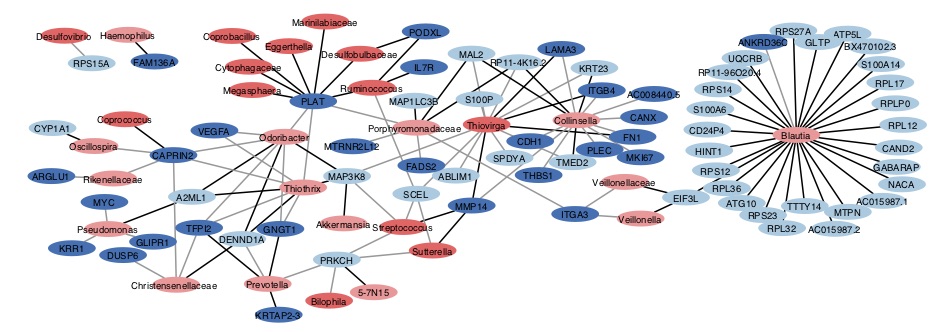
Characterization of the human gut microbiome is becoming increasingly prominent to understand inter-individual differences in health status and digestive processes. The human microbiome can be thought of as a variable local environment for the host cell in the specific body site. Thus host-microbiome interactions can be studied in the general framework of GxE. Our goal is to elucidate the cause-effect of the host-microbiome relationships and how they affect complex trait variation in humans. One of the main limitations to functional genomic studies of host-microbiome interactions in humans is the lack of a cell model that can be used for high-throughput studies and can be collected from population samples. We have established a 3D colonic organoid model to characterize the host regulatory changes determined by interaction with the gut microbiome across different individuals. We are using this model and functional genomics methods to characterize the host regulatory changes in response to presence of the gut microbiome (Richards et al, 2016, mSystems; Richards et al, 2018, Muehlbauer et al, 2021). We are also assembling a panel of microbiome sub-types across host physiological and pathological states (e.g. IBD), primate species, and human populations (through the Global Microbiome Conservancy project, http://microbiomeconservancy.org/), that we use to treat the human cells. We aim to identify human regulatory variants contributing to inter-individual variation in the response to the microbiome. These results will help us to understand the role of host-microbiome interactions on human complex traits.
 Luca Lab